

SEO for the Non-Techie: Busting SEO Jargon A Complete SEO Glossary for 2024

Are you a Digital Nomad💻 in Spain? Do you speak Spanish? Would your Erasmus year be different if you spoke fluent French or Mandarin?

Not knowing the language of a country, medicine, taxation, cookery or SEO–you are on the outside looking in.
The outside is cold, rain and not fun.
Being good at SEO is like eating lunch at the all-you-can-eat traffic buffet. Don’t be the runt of the runt of the litter getting crumbs.
SEO is far more than just fixing platform issues (Tech SEO). Every time I’ve ever calculated the ROI of SEO for a client, Tech SEO barely has any impact. Good content, on the other hand, makes a LOT of difference.
arroun nom
If you don’t learn and act, you’ll always be the runt of the litter, fighting for traffic crumbs.
Should you worry about the “URL is unknown to Google” warning message in GSC? Should you worry about backlinks, blacklists, or the algorithm core updates?
Now is the time to learn the language of SEO. Knowing SEO terminology will protect you from shady SEO firms that thrive on ignorance by befuddling, fooling, and abusing your lack of SEO knowledge.

Get au fait with SEO in 2024. Let’s start by busitng 🥊 a bit of SEO Jargon.
Successful people do things that the average person is not willing to do. They make sacrifices the average person is not willing to make. But the difference it makes is extraordinary.
Brian Tracy
This SEO jargon-busting article is divided into three easy-to-understand sections–On-Page SEO, Off-page SEO and Technical SEO.
The fourth leg of the SEO chair🪑 is content. We’ll leave the content for another article.
SEO is the RESULT of a great reputation, generating content, speaking at conferences, writing articles, and other activities that cause well-regarded people in your industry/area to link to you.
DY
Don’t worry, I am Urban Renström. There is always science and research involved in everything I talk about, teach, and demonstrate.
On-Page SEO Jargon Factors
On-page SEO is the process and practice of making pages and posts easy for
a) Google to understand the website content and
b) for people to consume the information and decide to buy your products.
Alt Text
Alt Tags, Alt Descriptions, Alternative text describe an image/graphic when a) the image fails to load correctly with the rest of the page and b) for accessibility reasons, e.g. sight-impaired people.
The alt text is also read by screen readers for Accessibility purposes. i.e., a blind person reading your page can understand the image from your Alt Text.
Anchor Text
Anchor text is the words put on a page instead of the actual link to another page.
For example, if I wanted to link to the Wikipedia “Anchor text” page, I could just put the URL on the page https://en.wikipedia.org/wiki/Anchor_text, but that is not the best for the user experience. Instead, you should type the words Anchor text and associate the link with those words. Like this Anchor Text.
Bounce Rate
The Bounce rate, as defined by Google in Universal Analytics (down revision but not GA4), is a session where a person visits one URL, does not click on any buttons, does not watch any videos, or does not click on links to visit any other page on the website and then leaves.
That one session has a bounce rate of 100%. The bounce rate is independent of the time spent on that page. The “ave time on page” is calculated by Google Analytics.
The bounce rate is a page ranking factor.
Content Lenght
The number of words on a page. Is there a sweet spot for content length?
It depends. #SorryNotSorry. Word count is not a direct SEO ranking factor.
Google tells us we must satisfy user intent. So, if your 100-word article answers the question people ask, then you are “good to go”. #NotSoFastAndEasy
However, article length and word count are correlated with a greater number of backlinks, which translates into higher SERP rankings (and therefore a higher click-through rate).
Content Optimization
Content optimisation ensures your page or post is findable by search engines (indexed–Technical SEO).
Ensuring search engines understand the context of the page (keywords, entities, titles, heading etc–on-page SEO).
Content optimization is the knowledge of how important your pages are compared to other pages and posts (backlinks, references etc–off-page SEO)
E-E-A-T
EEAT stand for Experience, Expertise, Authoritativeness, and Trustworthiness. They are the guidelines for search quality raters for websites. Some websites do get manually reviewed for their EEAT.
E-E-A-T is how websites are deemed worthy. The EEAT guidelines are one of the main methods Google uses to help determine rankings of URLs in the SEPR.
Is the info I’m reading written by an expert in the field? Do they have the experience to reinforce the expertise? Are they an authority in their field and is the website trustable?
External Links
From the on-page SEO perspective links from your website to other websites are external links.
GEO Tagging
Keyword geotagging is simply placing the name of your target location in your keywords. For example, “Best Plumber Dublin, “Best Electrician Everton”, “Best Indian Indiana”
Image Alt Text
See Alt text above
Images and Graphic
A picture is worth 1000 words. Add images and graphics to enhance the articles you publish.
Internal Linking
Internal linking is the process of connecting articles together to help the user better understand the subject or connect to relevant information or products and services.
Keyword Research
Keyword research is the process of finding words and phrases that people use to search for your product and services. The goal being your articles to match the intent of the person searching and therefore your article is shown on page 1 of Google SERP.
Keyword Density
Keyword density is the number of times your keyword is used in your article divided by the total number of words.
Too many and you are keyword stuffing and you may be labelled as spam. Not enough instances of your keyword and Google may have trouble understanding the subject of your page.
I used SEO Jargon X-times in this article and my SEO plugin, RankMath, decided it to be just above the minimum required.
Quality Rater Guidelines
The Google Quality Rater Guidelines also known as the Quality Evaluator Guidelines, provide instructions on how to evaluate the quality of websites.
The QRG is used to assess the reliability of our Search results and includes E-E-A-T criteria.
Meta Description
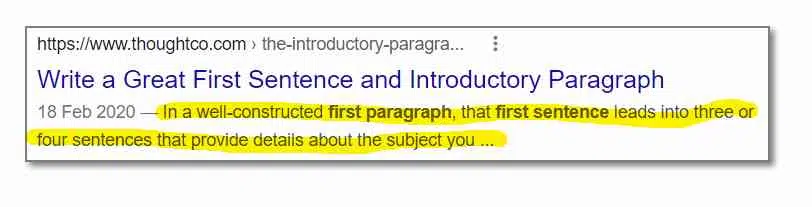
The meta description is the <=160-character-long description used to describe the page. In good quality modern WordPress SEO plugins, I recommend RankMath, this is easily done.
In the SERPs, the meta description is the yellow highlighted words in the image below.
Mobile Friendliness
It is the idea your website’s theme should adapt to screen size without losing any aspects from a large monitor.
SEO Writing
the process of writing content with the goal of ranking on the first page of search engines like Google.
SERP
Search Engine Results Page.
The Headline
The headline of your page is the most important part of your page.
If the headline does not compel people to click on the link in the SERPs then nothing else you’ve done matters.
David Ogilvy said 5x as many people read the headline as read the body copy.
“It isn’t the whiskey they choose, it’s the image.”
“The headlines which work best are those which promise the reader a benefit”
Title Tag
The title tag is an HTML element that specifies the title of a web page. Inside the red box is the title tag.

URL & Slug
This is the URL is everything in quotes “https://urbanrenstrom.com/seo-jargon/“
The slug is the “seo-jargon”. Which is also the keyword for this blog post article.
User experience, UX
For a website and SEO UX is all aspects of the users experience when interacting with your website. Colour, navigation, button placement, shape of the buttons etc.
Off-Page SEO Factors
Off-page SEO is the factors that occur off of your website that contribute towards improving your page authority (PA) or domain authority (DA). For example, links pointing to your website from various sources; all the Public Relations and profile-building efforts; all the social media marketing efforts
Off-page SEO refers to any and all SEO tactics applied outside of a website to improve a website’s search engine rankings.
Affiliate Marketing
Affiliate marketing is one of many online business models.
Being an affiliate is promoting other people’s or brands’ products and services and getting a commission on each sale.
For example, I’m an affiliate (and customer of) StellarWP. They own Kadence Theme and Kadence blocks, and they pay out a 35% commission on the retail price of the Kadence theme.
Backlinks
Backlinks are simply links from websites to yours. The more quality not spam backlinks you earn the better.
Many “SEO Agencies sell backlinks” as a service. #CaveatEmptor (buyer beware)
Blog Commenting
Blog commenting is the process of leaving comments on blog posts with the goal of
A) leaving a good comment,
B) improving your profile with their audience, and
C) getting links back to your own website.
D) growing your network and building relationships
Citations
Citations are an online reference to a business that features the business name, address, and phone number (NAP).
Content Marketing
Content Marketing is the process of marketing your business using content.
The goal of content and marketing is to sell more stuff easier.
Content marketing is the formal process of designing, researching, writing, editing, filming, producing and being the showrunner for your media empire.
The opposite of content marketing is RaP, random acts of publishing.
Directory Listing
See Google Business Profile, Tripadvisor, Yelp directory is a directory listing.
If you are a brick-and-mortar business getting customer reviews will help significantly.
Forum Posting
A forum is an online discussion website, where you can ask or answer questions, and add comments to existing posts.
Your signature or profile will have links to your website or social handles. Forums are an excellent way to demonstrate expertise in your area.
Popular forum sites are
📌 Stackoverflow
📌 Quora
📌 Reddit
📌 WarriorFourm
Google Business Profile
Another free service from Google. Google:
“Google Business Profile is an easy-to-use tool for businesses and organizations to manage their online presence. You can verify your business and edit your business information.”
Guest Blogging
Guest blogging is publishing articles on other websites to
A) gaining exposure to new audiences,
B) demonstrating your expertise,
C) building backlinks to your website.
D) plus other really good reasons 🤘🏻
Influencer Marketing
Influencer marketing is the paid part of POEM.
Influencer marketing is paying a person or brand to “promote” your product/service.
This is gaining exposure to your product/service to new audiences.
Local Citations
Local Citations are a central and key foundational SEO tactic for local businesses.
Local businesses are your neighbourhood butcher, plumber, florist, restaurant, accountant, etc.
Money phrases & Money pages
money phrases & money pages
Money pages are the pages on your website that rank high on the SERP, usually on page 1 and are the main contributors to revenue.
Money phrases are the keywords/phrases your money page rank for.
NAP
NAP is an acronym that stands for name, address, and phone number.
Google’s local algorithm looks at your NAP information as a signal of relevancy and proof that you’re a legitimate local business and actually located at the address listed in your Google My Business profile.
PNB SEO
PNB SEO is an acronym for a private blog network. It is a grey hat SEO tactic where one person owns a number of different websites in different niches and each one links back to the main website.
The goal is to improve the organic ranking of the target website, to boost its authority and ranking power by having many different websites link back to the target website.
In the short time frame, the rankings of the main website may/will increase. But because using a PNB is risky the worst-case scenario, your rankings will plummet once Google discovers them.
Public Relations
Leveraging PR is an excellent method of gaining exposure to new audiences.
PR brings the audiences to the door, marketing brings them in and sales convert them into cash (customers).

Quality Score SEO
Not an SEO-specific measure.
Quality score is mostly related to Google ads and measures the ads’ relevance, expected CTR, and landing page experience.
Reviews, Recommendations
Online reviews are a proxy for recommendations from a friend.
Reviews are a bottom-of-the-funnel tactic which helps people in their decision marketing process.
For example, when booking a restaurant for your 20th wedding anniversary–do you book the 3.5-rated local gastro pub or the ⭐⭐Micheline star fine dining establishment?
ROI of SEO
Return On Investment of SEO efforts. The simple calculation is if you spend €1000 on SEO activities and get €2000 in business then your ROI=2.
2K output, revenue from 1K input.
Note that SEO is a long-term play and “your results will vary”. Vary in quality and TtA (time to achieve).
Social Media Marketing
Social media does not have a direct impact on SERP ranking. However, link sharing and exposure do influence SEO efforts.
More exposure is better than less exposure.
Social Signals
Social signals are the collective social shares, Tweets, FB shares, Pinterest Pins and overall social media visibility.
Collectively these activities contribute to a page’s organic search ranking and improve Page Authority and Domain Authority.
Technical SEO Factors
SEO Jargon Busting the Technical SEO Factors. Technical SEO is a process. It is the process of optimizing your website and server architecture in a way that enables search engine spiders to crawl and index your website more effectively.
By focusing on Technical SEO, website owners aim to improve their organic search ranking by ensuring that their site can be more easily and accurately understood by all search engines.
Algorithm–Google
Our entire online life is controlled by algorithms–FB, T, LI, IG, TT and Google.
So Google’s long-term stated goal is to satisfy user intent.
The only way to get the best, relevant, and current results for people is to filter out results which are not the “best, relevant, or current”.
The Google search algorithm does that very well. The Google search algorithm is many different algorithms that consider many factors including quality, usability, relevance, spam etc.
The main algorithm consists of 200 different factors used to find, rank and return the most relevant pages.
AMP Definition (Accelerated Mobile Pages)
AMP stands for Accelerated Mobile Pages. AMP was created by Google as a competitor to Facebook Instant Articles and Apple News.
AMP was designed for mobile browsing with the intention of helping web pages load faster. In 2015, when introduced, most websites were not designed as responsive or mobile-friendly. In 2021 some apps are discontinuing support for AMP.
If you are using AMP the Google recommendation is to upgrade your website theme to a newer one.
Backlinks
Backlinks are simply either asynchronous or synchronous links from websites to yours.
Each link that points to your website, pages or post, Google notes as a ‘vote’ of confidence. The more ‘votes’ you get the more important Google believes your pages and posts are.
Keep in mind not all links are created equal. If you have dozens of links coming from known low-quality websites then your site can be punished or your site devalued.
Links from high DA, (domain authority) websites have more weight and are better than those from low DA websites.
Breadcrumb
Breadcrumbs are the trail of links at the top of the page, usually under the title and under the author and date info. Breadcrumbs are a required part of basic web design.
Breadcrumbs are these little navigational aids that don’t just tell people where they are on your site, but breadcrumbs importantly also help Google work out how your site is structured.

Broken Links
Broken links are links which are not connected any longer…🔗 to the original location.
For Example, if this post links to an “SEO for noobs” post and I then change the URL for that post to “SEO for beginners”. Then the new URL is different and the link is broken.
Core Web Vitals
CWV is a metric of a healthy or unhealthy website.
CWV metrics measure many factors of a website. Optimizing for quality of user experience for visitors, customers and clients is key to the long-term success of your business.
CWV will assess the current state of your website and identify opportunities to improve.
Test your website here: https://pagespeed.web.dev/
Core Web Vitals rates pages based on:
*Largest Contentful Paint (LCP)
*First Input Delay (FID), and
*Cumulative Layout Shift (CLS) and reports back using green, yellow, or red traffic light systems.
CWV is a search ranking factor. Most important is that CWV has a business impact. People leave slow-loading websites, don’t like waiting to press buttons and don’t like websites that shift around.

Click-through Rate (CTR)
CTR is a simple math calculation.
For organic search, it is the number of people who clicked on the link in a search result vs the number of impressions the link received.
E.g. 151/11896 = 0.01269. (In percentage) 0.01269 *100 = 1.27% CTR

Crawlers
Crawlers, web crawlers, and bots are automated “program” which has the job of indexing the content of websites. Index means to catalogue.
They browse the web, index, and store information about the pages and posts it visits.
These bots make a copy of the page and add the URL to the index.
Crawl Errors
For example when the bots try to reach one of your pages or your website and fail. See the Crawling stats/report in your Google Search Console.
The two main types of crawl errors are 1) site errors and 2) URL errors

Domain Authority (DA)
Domain Authority describes a website’s relevance for a specific subject area or industry.
DA is a search engine ranking score developed by Moz.com. The DA has relevance in so far as it has a direct impact on its ranking by search engines.
Go to Moz here to check the DA of your website
Index/Indexing
An index is when the “GoogleBot” visits and analyses your pages for context and meaning, and stores the results in the index for future retrieval.
Google, Bing, Yahoo, etc. all index pages.
Google Analytics (Universal Analytics)
Google Analytics is a web analytics tool from Google that tracks and reports on traffic to your website.
A web analytics tool is required to monitor and improve the performance of your website.
Note–GA reports on what people did on your website.
Note 2–GA is depreciated on July 2023 and replaced with Google Analytics 4
Google Search Console
GSC is another free tool from Google, and its brilliance is that it provides information on how Google crawls, indexes and services your website.
Google Search Console also gives useful information on the
▶ keywords people used to find your pages
▶keyword ranking
▶CWV
▶and search results
HTTP errors
Sometimes a website hiccups and navigating does not work as planned. HTTP errors to the rescue.
HTTP errors are warning labels that something is not right.
For Example, common HTTP errors are
👉 HTTP Error 404 (Not Found) which is the page you looked for is not available.
👉 HTTP Error 500 (Internal Server Error) means the server serving up the web page encountered an internal error.
👉 HTTP Error 401 (Unauthorized) When a visitor tries to access a restricted page they
👉 HTTP Error
👉 HTTP Error
Keyword Cannibalization
Your goal, The Goal is that each page ranks for different keywords.
E.g page A for “oven mitts”, page B for “mitts for ovens”. One challenge is when page A ranks for “oven mitts” and “mitts for ovens”.
Page A is then cannibalizing page B’s keywords. As in ranking for unintended keywords and worse taking traffic and ranking from page B.
Mobile-First Indexing
In September 2020 Google switched to mobile-first indexing from a desktop first.
This means Google uses a smartphone agent, a bot to index your pages. This change is because most (>50%) of people use a mobile phone whilst visiting websites (your visitor results will vary, check using Google Analytics 4).
Naturally, your theme must be responsive, and you should build blog posts etc. with a mobile-first point of view.
Mobile-friendliness
The ability of your website’s theme to adapt itself to different viewing devices. Every modern theme will be responsive.
Check your website using a (not an affiliated link) checker.
Page Authority (PA)
Page Authority is a score that predicts how a page will rank on a search engine’s results page for a specific keyword.
The score is a logarithmic scale from 0-100.
Recall DA (domain authority) measures the strength of the entire domain or subdomain, not individual pages.
Page Speed Issues
Recall from CWV one of the metrics is the Large Contiful Paint, (LCP) which measures the loading performance, i.e. speed of the page.
When your page load time is > 2.5 seconds your user experience is poor, your page rankings will drop, and people will not wait for your website to load, leads will drop, and revenue will drop.
Redirects
Redirect is a Technical SEO term. Redirects are the practice of sending people from one URL to another.
For Example, if I change the URL of the blog post from “/blogging for business” to “/the business of blogging” then I would use the “301 Permanent Move” redirect.
Speed Optimization
The process of improving the speed of your website. The good part of using the page speed insight test is the results tell you what requires improvement.
E.g. large images, slow server response time, or software code slowing load times.
SSL Certificate
SSL stand for Secure Sockets Layer. And is a protocol technology standard for keeping connections between internet connections safe and secure. It uses protocols for establishing authenticated and encrypted links between computers.
URL structure
1stly–Uniform Resource Locator (URL), is commonly referred to as a web address. ?????
Schema Markup
Also, structured data, is the language search engines use to read and understand the content of your pages and posts.
There are >19 different schemas available–Article, Book, Event, HowTo, FAQ, FactCheck, Music, Job Posting, Video, etc.
For example, If you use the Book schema to describe your book then search engines understand your page is about a book.
Website Hosting
Where to host your website is a critical factor for speed, usability and function.
Website hosting is an online service that holds the content and serves up your website for users. The cheapest is not always the best for your use case.
Website Site Architecture
Site architecture is important for user experience and SEO.
Like this

XML sitemaps
XML sitemaps are often recommended as an SEO best practice.
XML sitemap is an index of all the content on your website. It helps search engines navigate your website most efficiently by offering a hierarchical view of your content.
SEO Jargon Busting SEO Glossary for 2023 version.
SEO for Non-Techies: Your Priority Reading List
In an earlier📆 article, we showed why the SERP page is the “best-fit answer” to the questions people ask and why you must rank on page 1 to get the flood of traffic.
This 👉 article tackled the question of how SEO helps grow a business. This April 2023 article dug into the importance of SEO to boost the visibility of an online business.
We also discussed the 12 basic concepts of search engine optimization. And dove deeper into how the 3 Pillars of SEO play together to improve the visibility of pages and posts to help get more organic traffic.
We also discussed how to unlock SEO for online success.
We also saw that Google page 2-♾ is the “dead man zone” and “where the bodies are!” ☠.


Getting a Tsunami of Organic Traffic?
Worse is the dwindling email list, the bare appointment book and the underperforming online courses. Time to turn the trickle into a torrent.